


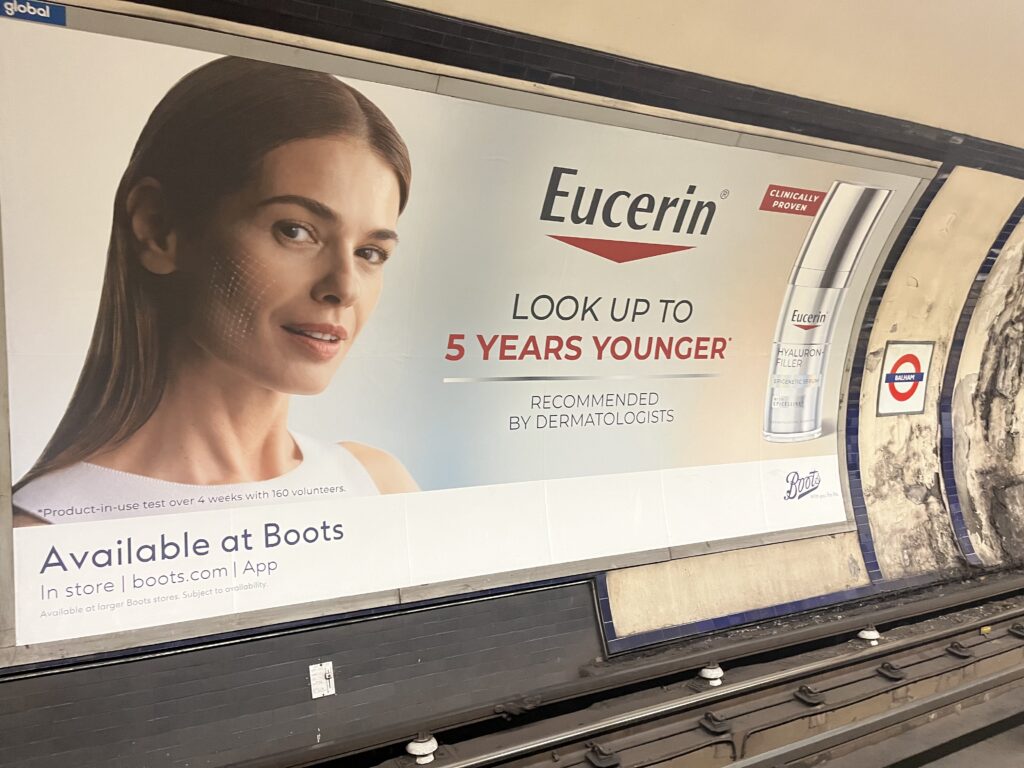
The Advertising Standards Authority (ASA) has banned an advert promoting a skincare serum from skincare company Eucerin.
The advert, which appeared on a billboard at Balham Tube station in London, received a complaint in November 2025. The advert claimed that the Eucerin Hyaluron-Filler Epigenetic Serum was ‘clinically proven,’ based on a study of 160 participants who used the product for four weeks before being asked how much younger they believed they looked.
The ASA raised concerns following a complaint questioning whether the claim “Look up to five years younger” was misleading and whether it was adequately substantiated.
Beiersdorf UK, which is responsible for the marketing, sales, supply chain and brand management of Eucerin in the UK, stated during the investigation that the “up to five years younger” claim reflected a genuine maximum result rather than a typical outcome.
The company also provided three additional studies and one peer-reviewed research paper, conducted by independent research institutes and Beiersdorf research teams. Beiersdorf UK stated that these studies contained supporting information but did not directly substantiate the claim.
Gemma Allwood, investigations executive at the ASA, commented, “People expect skincare ads to give them a realistic sense of what a product can achieve. Advertisers should make sure that claims implying measurable or clinically proven results are supported by robust evidence. In this case, we considered the claim that the serum was clinically proven to give a more youthful appearance of up to five years to be an objective one and we therefore expected to see strong supporting evidence to back this up. Because we hadn’t seen sufficient evidence to substantiate this efficacy claim, we found that it was misleading.”
Aesthetics also reached out to Eucerin, and a spokesperson commented, “All efficacy claims made in relation to Eucerin products are supported by scientific research. We acknowledge and respect the ASA’s ruling regarding this specific UK billboard execution and have cooperated fully. The advertisement in question is no longer live in the UK. We are confident in the scientific evidence underpinning our products and the claims we use in our advertising and marketing materials. All of the studies we cite are carried out in line with specialty standards.”