


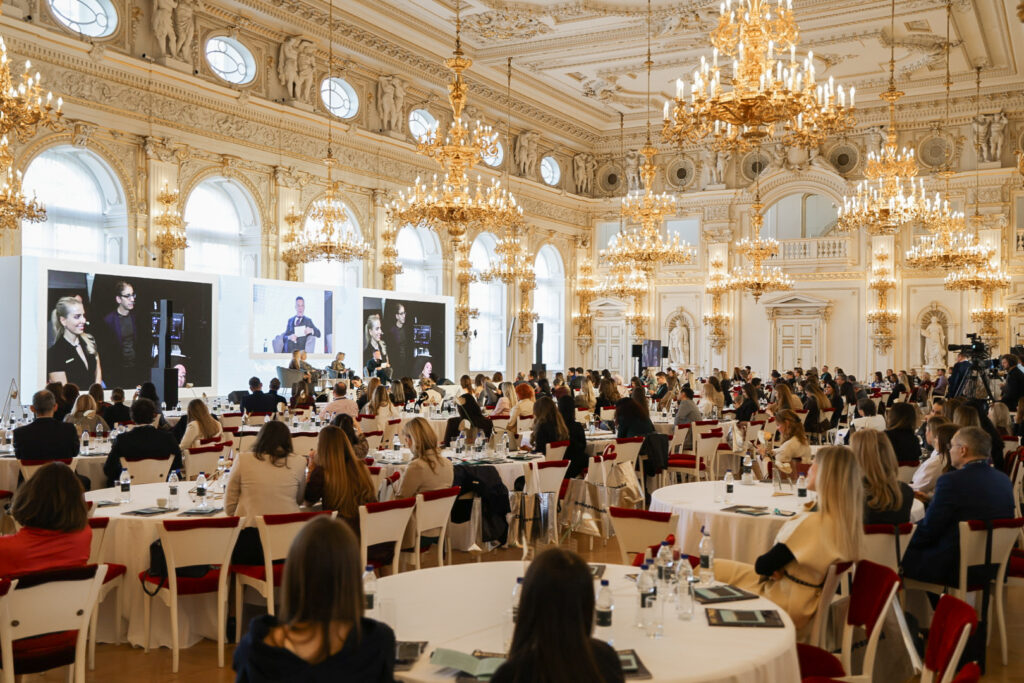
Aesthetics was invited to this year’s Aesthetic Dialogue, held on November 14-15 at Prague Castle, Czech Republic.
The two-day event attracted 360 delegates from 29 countries across five continents, 20 exhibitors and 29 speakers presenting across the Main and Innovation stage.
The conference opened with Prague LAB owners, maxillofacial surgeon Dr Monika Kavková and Eva Osvaldová, followed by Dr Jani van Loghem and Dr Lee Walker’s session titled, ‘Where We Are in Aesthetic Medicine: Improving Quality of Life’. Dr Walker went on to explore ‘Beauty and Attractiveness: Age-Related Treatment Options,’ before Dr Loghem returned to discuss ethnic differences in aesthetic assessment and treatment.
Day one covered a broad spectrum of upper-face topics, including biorevitalisation, structural optimisation prior to filler placement, and the integration of dual-layer regenerative treatments with volume correction. This segment was led by oral and maxillofacial surgeon Dr Yuliya Gusarova. Plastic and reconstructive surgeon Dr Luciano Lanfranchi followed with a live upper-face anatomy demonstration, complemented by Dr Steven Harris’ live ultrasound assessment of the same region.
The afternoon sessions focused on the retinacular cutis and facial ligaments, with Dr Evgeniya Shelemba outlining treatment strategies for these connective structures. Attention then shifted to non-surgical approaches for the periorbital region, with insights from Dr Kyu Ho Yi, Dr Kavková and Dr Loghem. Plastic surgeon Dr Konstantin Frank expanded on considerations for treating both younger and older patient groups.
After the lunch interval, delegates heard from further international speakers including Dr Lim Ting Song, Dr Sonja Sattler, Dr Loghem, Dr Frank, Dr Harris, Dr Andrew R. Christie Schwarz, Dr Panajot Papa and Dr Katinka Pónyai. Topics included ‘Toxin Mastering the Full-Face Lift’, ‘Botulinum Toxin Explain: Structure, Function and Mechanism,’ and live assessments of mid-face patients, covering the tear trough, cheeks, pyriform fossa and nose, alongside discussion of the role of the SMAS in aesthetic procedures.
The panel discussion prompted thoughtful consideration on several topics, including the use of ultrasound as a diagnostic tool for assessing fillers in clinic, and a debate around the term “lifting effect” in relation to hyaluronic acid, questioning whether it fully captures its actual function.
Day two reflected the event’s multidisciplinary nature bringing in speakers for a series of focused sessions spanning injectables, complications, threads, product innovation and medical aesthetic research. Additional speakers included Dr Roshan Ravindran, Dr Omar Haroon, Dr Michael Kim, Professor Sky Wong and Professor Lee Smith.
The morning opened with a series of practical demonstrations centred on nasolabial fold treatment, comparing cannula and needle approaches and examining material behaviour, followed by updates on hyaluronic acid biomodulators and current philosophies in injection strategy. Lip techniques were a strong feature of the early agenda, with speakers presenting contrasting methods for natural shaping, tool selection and aesthetic balance.
Mid-morning sessions moved into full-face assessment, tear trough management and neck rejuvenation, with anatomy and safety repeatedly emphasised across a multi-speaker segment. The morning closed with an overview of evolving treatment standards and risk-aware practice.
The afternoon shifted towards research, complications and correction strategies, providing delegates with evidence-led insights into adverse event recognition and aesthetic revision. Technology integration took centre stage with a session on thread indications supported by VECTRA H2 imaging, followed by a panel discussion exploring practical applications and patient management.
The day concluded with updates on biomodulators for the neck and décolletage, rounding off a programme focused on safe, anatomically grounded practice and emerging innovations in the aesthetic field. Delegates were invited to a gala dinner at National House Vinohrady to reflect on the event.
When asked by Aesthetics about the significance of presenting as a speaker and its impact on the future of the specialty, Dr Schwarz commented, “Aesthetic Dialogue has the versatility and the variety to look at all aspects of regeneration and aesthetics. What I like is that there’s presentations about health of the body, psychology, mindfulness in combination with regenerative therapies and our usual injectables and aesthetic procedures. It is more holistic, taking the modern patient more seriously, becoming less of a money-making machine and more of a journey for both the practitioner and the patient themselves.”
In an exclusive interview with Aesthetics, Dr Kavková reflected on the conference’s emphasis on “dialogue” and what this approach offers delegates. She commented, “The idea behind it was to show the audience every possible perspective in their everyday life and practice. It’s not just about what companies say or what doctors say, but really focusing on open and transparent discussion and dialogue between the best possible experts in the world.”