


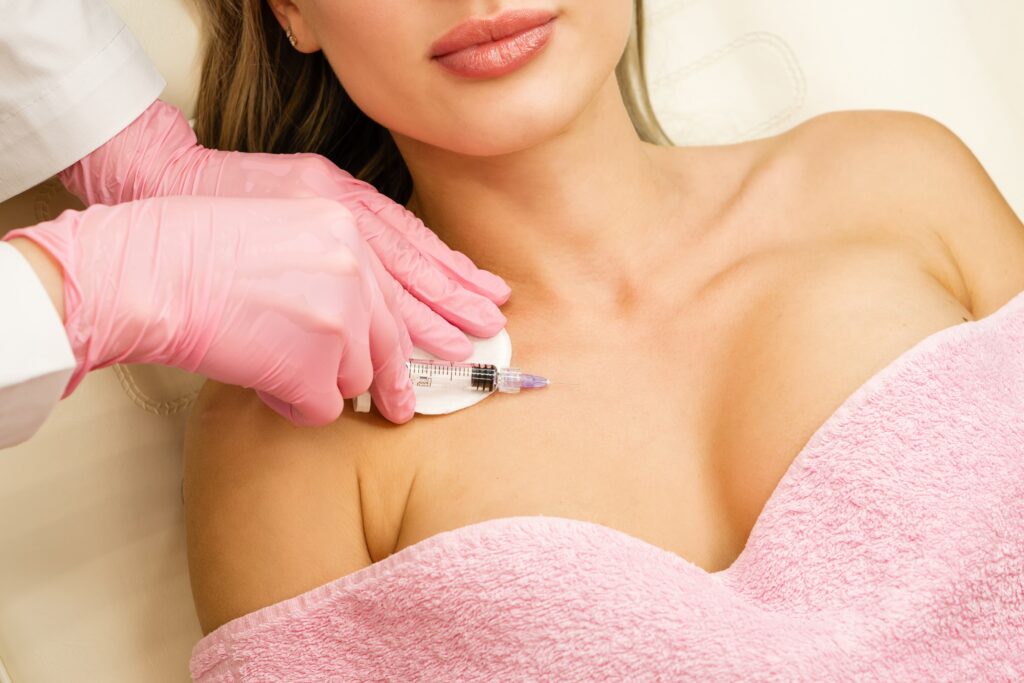
Aesthetics explores calls for an immediate ban on dermal fillers being used for breast augmentations
Medical aesthetic and surgical groups across the UK are advocating for an immediate prohibition on the injection of synthetic dermal fillers into breast tissue, according to the British Association of Aesthetic Plastic Surgeons (BAAPS).¹
BAAPS maintains that there is “no justification whatsoever” for the administration of dermal fillers in the breast region, characterising the practice as ‘high-risk’ and of limited therapeutic or aesthetic benefit. The call follows renewed debate around the regulation of high-risk aesthetic procedures in the UK, as the Government prepares to introduce a licensing scheme for non-surgical cosmetic treatments.²
The British Association of Medical Aesthetic Nurses (BAMAN) and The British College of Aesthetic Medicine (BCAM) told Aesthetics that they support BAAPS’ call for an outright ban. Gareth Lewis, chief operating officer at BAMAN, commented, “As a professional association representing nurses working in medical aesthetics, BAMAN believes that procedures with a high-risk profile and limited evidence base should not be performed. We support stronger regulatory oversight within the aesthetics sector and welcome calls for clearer guidance and restrictions to better protect patients.”
Current regulatory framework
Under current guidelines, there are no mandatory licensing requirements for individuals offering dermal fillers, unless the treatment involves a surgical procedure or is carried out by a healthcare professional (HCP) in a regulated setting.² This has led to variation in practitioner qualifications and oversight, particularly for higher-risk procedures.²
BAAPS shared with Aesthetics that the organisation is now raising awareness of the issue, as regulation of non-surgical procedures has recently come into force in Scotland, with England potentially following soon. BAAPS believes this is the right moment to ensure the regulatory framework is implemented properly. BAAPS president and consultant plastic surgeon Ms Nora Nugent explains that under the licensing scheme, breast fillers would fall into the Red Category and therefore be categorised as high risk for only doctors to perform.² However, Ms Nugent believes that licensing does not go far enough, and for this specific procedure, there are no benefits to outweigh the risks involved.
Safety concerns
BAAPS has referenced several complications following the use of synthetic dermal fillers in breast tissue, including severe mastitis, abscesses requiring surgery, hard and misshapen lumps, migration of filler to other areas of the body, long-term pain and interference with breastfeeding.¹ Aesthetic practitioner and BCAM member who advocates for patient safety across the sector, Dr Darren McKeown, suggests that breast fillers may pose a greater risk by potentially interfering with cancer detection.
Dr McKeown explains that all fillers carry a risk of nodules and inflammatory reactions. In most areas of the body, if a new lump appears at the site of a previous filler injection, clinicians can reasonably assume it is likely related to the filler itself. However, he warns that the situation is very different in breast tissue, saying, “Assuming that a new lump in a patient with prior breast filler is simply a filler-related issue would be a high-risk strategy.”
In reality, Dr McKeown says, the lump could just as easily represent a new cancer, and distinguishing between the two can be extremely difficult. “We know that breast fillers make the interpretation of mammograms much more challenging and can delay the diagnosis and treatment of cancer. For me, this makes the procedure unacceptably high risk,” he explains.
The impact of social media
The promotion of breast filler treatments on social media, combined with the appeal of non-surgical breast enhancement, continues to drive patient interest. To illustrate, in 2024 the Advertising Standards Authority (ASA) and the Committee of Advertising Practice (CAP), took action against treatment provider CCskinlondondubai. The company was found to be pressuring patients into booking dermal filler breast procedures through flash sales, exploiting women’s body image insecurities, and trivialising the risks associated with cosmetic interventions.⁴
Both Ms Nugent and Dr McKeown believe that, in regard to protecting the public against dermal fillers being used in the breast region, education alone is not enough to mitigate the risks. Dr McKeown says, “Those in vulnerable positions will still make unwise choices, particularly if they are being influenced by reckless marketing on social media. That’s why we need robust regulation to prevent people from making decisions that are a significant danger to their own health.”
Practitioner responsibility
Ms Nugent adds that from an aesthetic practitioner’s perspective, being aware of the risks and problems associated with dermal fillers in the breast region is key. “Practising within your scope of training and experience is important,” she says, highlighting, “If you do not normally treat breast conditions and/or do not have a good understanding of breast physiology and pathology, do not place dermal fillers within breasts.”
Ms Nugent adds that should a patient request a breast enhancement, practitioners must refer them to a qualified plastic surgeon, rather than undertaking the procedure themselves or directing the patient to someone without appropriate training in aesthetic breast surgery or breast disease.
Prioritising patient safety
In response to concerns that an outright ban could drive patients to seek the procedure through unsafe channels, Ms Nugent adds, “We cannot shy away from denouncing a harmful procedure simply because an unscrupulous practitioners will continue to carry it out underground. What is needed are robust legal consequences for those who put patients at risk by performing high-risk procedures in non-clinical settings, without the qualifications.”
Dr McKeown agrees that a complete ban on breast fillers is the only sensible move forward, concluding, “If this drives the practice underground, then in the same way we have enforcement in place with other people who break the law, we need to see robust enforcement to prevent and deter it. This is a serious public health issue affecting women, and it must be recognised and treated as such.”
References
- Plastic Surgeons Demand BAN on ‘Dangerous’ Breast Fillers Amid Cancer Fears | The British Association of Aesthetic Plastic Surgeons
- Department of Health and Social Care, Licensing of Non-Surgical Cosmetic Procedures in England (London: GOV.UK, 2025) Licensing of non-surgical cosmetic procedures – GOV.UK
- Cosmetic-interventions-AG-Final.pdf
- CCskinlondondubai – ASA | CAP