


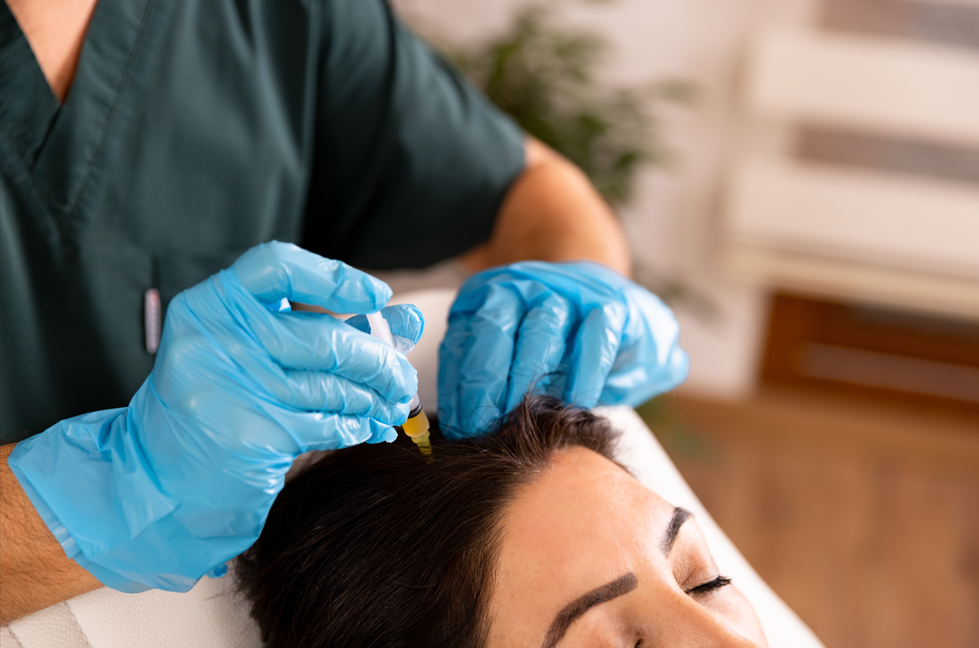
Aesthetics explores the implications of the new PRP Guidance for hair restoration
The Joint Council for Cosmetic Practitioners (JCCP) has published new Guidance for platelet-rich plasma (PRP) procedures confirming that the treatment of hair loss caused by, for instance, androgenetic alopecia, is a medical procedure.1 PRP is therefore regarded as a medicinal product where medicinal claims are made.1 The Guidance, aimed primarily at Local Authorities that identify businesses or receive complaints relating to PRP procedures, was developed by a panel of health protection specialists and healthcare professionals (HCPs) at the request of the JCCP, in collaboration with relevant regulators.1
Regulatory overview
Within the proposed licensing scheme for non-surgical cosmetic procedures in England, PRP therapy for cosmetic purposes is provisionally within the Amber category, which is classified as including procedures with a medium risk of complications.2 However, the consultation response published in August 2025 noted that PRP was among the procedures identified by respondents as warranting reclassification to the Red category. This would require treatments to be carried out by qualified and regulated HCPs working out of Care Quality Commission (CQC)-registered premises.2
In the recently published JCCP Guidance, the CQC confirms that hair restoration procedures constitute a regulated activity when carried out by a regulated HCP.1 The MHRA states, “Claims to reverse permanent hair loss, cause hair growth or re-grow lost hair are medicinal claims, so the claims to stimulate and promote new hair growth, increase blood flow to the follicles and that the product is an alternative to transplant, are medicinal.”1
The MHRA advises that practitioners and suppliers who are not legally entitled to possess wholesale stock medicines must not promote the use of PRP for medical purposes. The Guidance continues, “We note the recommendations in UK devolved administrations to restrict the PRP procedures to regulated HCPs. Given the current and emerging understanding of the risk attached to the procedure, we support this position and recommend that similar positioning is considered in England.”1
Wider implications
The Guidance claims, “Any PRP procedure for hair loss, the treatment of joints or wherever a medical claim or diagnosis is made, is restricted to doctors and dentists operating within CQC-registered facilities.”1 Hair transplant surgeon Mr Greg Williams believes it still remains unclear which HCPs will be legally permitted to carry out the various stages involved in procuring, manufacturing and administering PRP.
He states that, unlike other prescription medicines, the centrifuge step constitutes the ‘manufacturing’ of the medicine and would therefore require a manufacturing licence, which Mr Williams explains doctors and dentists are exempt from.3
Andrew Rankin, acting co-chair of the JCCP explains that context is important, particularly since a definitive answer remains to be determined. This is because there are two areas of medicines legislation to understand. He explains that manufacturing requires a doctor, a dentist or an MHRA license. The second is the wholesale supply of unlicensed medicines, where the doctor is supplying an unlicensed medicine in a way that a pharmacy normally would, against a prescription. This is not allowed across different organisations, but it may be permitted within the same organisation, though yet to be determined.
In regard to whether nurses and pharmacists will be able to administer PRP for medical purposes, Rankin, explains, “I expect that nurses and pharmacists might be able to administer PRP for medical purposes when it has been prepared by a doctor or dentist within the same practice setting. Such practitioners would be accountable for administration without supervision. Assuming that they are trained and competent, and they would be accountable for their actions. The question is, are nurse or pharmacist independent prescribers administering it against the directions of the doctor, or are they requesting supply from the doctor for autonomous administration (without direction).” However, he adds that this is subject to MHRA determination.
Practical implications in clinic
Dr Shirin Lakhani, chair of the working group that developed this guidance, sees the potential requirement for CQC registration as one of the most significant aspects of the Guidance. She notes, “Its implications are substantial because they involve governance, quality assurance, patient safety, record keeping, incident reporting and ongoing accountability.”
Dr Lakhani believes an immediate priority is equipment, with clinics required to demonstrate that centrifuges, tubes and consumables are appropriate for PRP. “These should be sourced through legitimate suppliers, maintained in accordance with manufacturer instructions and supported by appropriate infection-control processes,” she notes.
She continues, “Providers should review their governance arrangements, standard operating procedures, consent processes, adverse-event reporting pathways, patient identification procedures and emergency preparedness.”
Marketing ramifications
Under the Guidance, treating hair loss can constitute a medical claim. Dr Lakhani warns, “The distinction is important because the way a treatment is presented can have significant regulatory implications. The line is crossed when marketing moves beyond describing the procedure itself and begins making claims about treating a medical condition or producing a specific physiological effect.”
Mr Williams notes that in the UK, prescription medications cannot be advertised. He explains, “If PRP injected for a medical purpose, such as for hair loss, is to be considered a prescription medication, then it would no longer be legal to advertise it.”4
Potential repercussions
Rankin notes that the key question is how independent prescribers will operate in practice, adding, “The JCCP has further work to do to understand this detail. In the meantime, anyone wishing to provide PRP alongside a medical or dental practitioner is advised to seek advice from the MHRA in relation to their particular circumstances.”
Rankin shares that the MHRA can take action for medicines enforcement issues. He continues, “The Guidance allows Local Authority Officers to assess risk, and they may serve improvement or prohibition notices depending on the findings and the extent of the risk.”
References
- Joint Council for Cosmetic Practitioners, ‘Platelet-Rich Plasma (PRP) in Aesthetic Procedures’, JCCP https://www.jccp.org.uk/ckfinder/userfiles/files/Platelet-Rich%20Plasma%20(PRP)%20in%20Aesthetic%20Procedures.pdf
- Department of Health and Social Care, ‘The Licensing of Non-Surgical Cosmetic Procedures in England: Consultation Response’, GOV.UK, 2025 https://www.gov.uk/government/consultations/the-licensing-of-non-surgical-cosmetic-procedures-in-england
- Scottish Government, ‘Regulation and Licensing of Non-Surgical Cosmetic Procedures: Consultation Background Paper’, gov.scot, 2024 https://www.gov.scot/publications/regulation-licensing-non-surgical-cosmetic-procedures-consultation-background-paper/
- https://www.gov.uk/guidance/apply-for-manufacturer-or-wholesaler-of-medicines-licences
- Advertising Standards Authority, ‘Prescription for Compliance – POMs and the Code’, ASA, 25 April 2024 https://www.asa.org.uk/news/prescription-for-compliance-poms-and-the-code.html