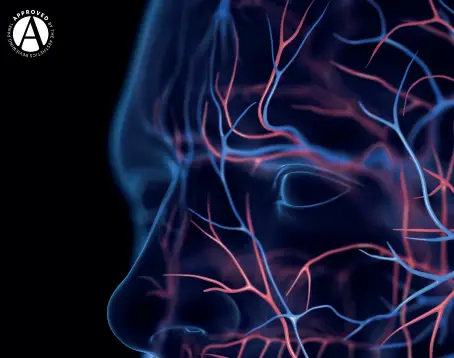
The facial arterial blood supply originates from both the internal and external carotid systems, with anastomoses connecting the two systems.1 The arterial supply is highly variable in distribution and depth between individual faces, and indeed between contralateral sides of the same face.1 Knowledge of this is vital to deliver the lowest risk aesthetic injectable procedures.
Certain facial features display more vascular variability than others, in vessel location, course and depth. There has long been cadaveric analysis on vascular variations, and more recently there are growing findings based on doppler ultrasonography analysis of real-time dynamic anatomy.2 Ultrasound plays an instrumental role for injectors in identifying vascular variations on a day-to-day basis in a clinical setting and is contributing hugely to continuous studies and emerging evidence on anatomical variations.3,4
As medical aesthetic injectors, it is hugely worthwhile having awareness of variations in some of the most commonly injected areas of the face – the forehead, the temple, the cheek, the nose, the lip…