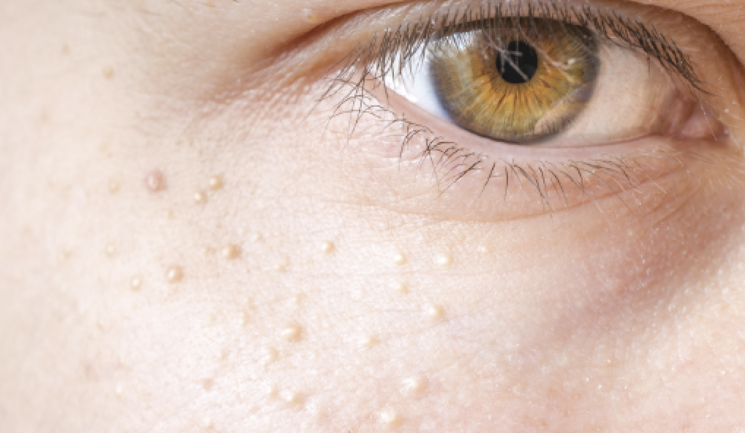
There are commonly two types of milia; primary and secondary. Primary milia comprises benign, keratin-filled cysts, derived from the pilosebaceous follicle, seen just under the skin’s surface,1 whereas secondary milia is an inflammatory condition characterised by plaques of milia.2,3,4 In children and adults (both men and women), they usually arise around the eye and on the cheeks; there is no evidence to explain exactly why these areas are affected more than others, but it may be because the skin is often thinner in these locations.5 Primary milia is frequently seen in infants, typically referred to as milk spots which often resolves itself. However, milia seen in adults is usually chronic; the evidence for why is unknown. It can be regarded as unsightly for some individuals and is difficult to cover with make-up due to its bumpy effect. The cause of milia in infants is also unclear…