


Aesthetics investigates the risks and repercussions of inappropriate weight-loss prescribing
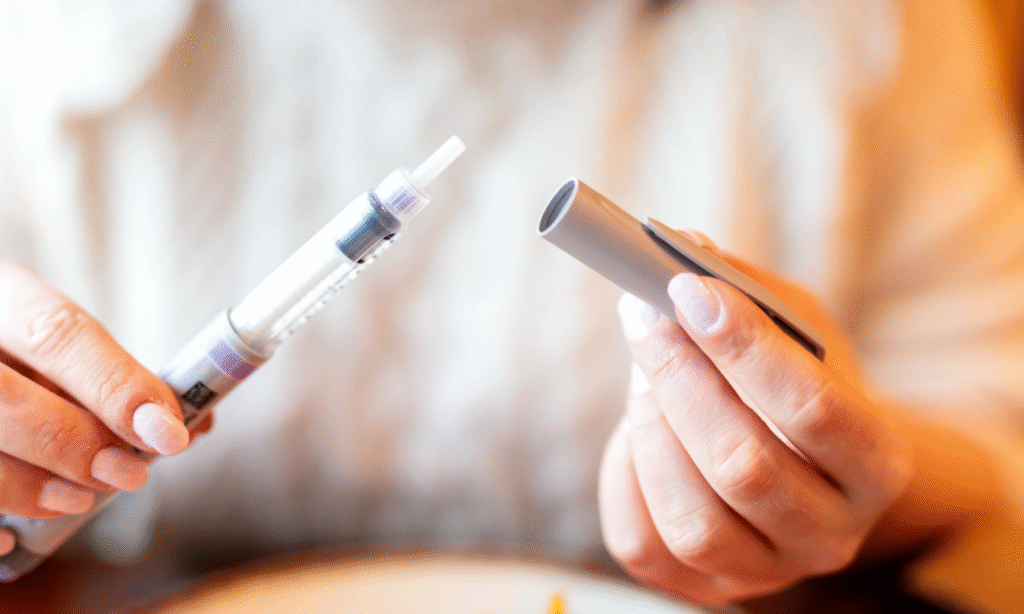
An ITV News investigation has revealed that young people with a healthy body mass index (BMI) are using artificial intelligence (AI) and basic photo-editing tools to obtain prescription weight-loss medication online.1
To explore how easily these systems could be bypassed, an ITV reporter used basic editing software to enlarge their face, waist and body before sending the image to several online pharmacies. Within a week, three separate pharmacies approved the reporter for weight-loss medication, with prescriptions subsequently issued.1 ITV found that this was not an isolated incident, as three additional women were
also approved for weight-loss medication, sometimes using only a single edited image.1 Following the investigation, the General Pharmaceutical Council (GPhC) has confirmed that all three pharmacies have been inspected. Two were found to not meet the GPhC’s standards, while one remains under investigation.1 This has caused concern in the aesthetics specialty, with the findings highlighting wider consequences beyond online prescribing, particularly for aesthetic practitioners who are increasingly seeing the effects of rapid weight loss in clinic.
Current regulation
Under General Pharmaceutical Council (GPhC) guidance, before prescribing weight-loss medication, the prescriber must independently verify a person’s weight, height and/or BMI to support safe decision-making.2 The guidance also requires two-way communication between the prescriber and the patient for all online prescribing. However, this consultation does not have to take place face to face; remote consultations are permitted for weight-management medicines, provided the prescriber has sufficient information to prescribe safely.2,3 This approach differs from the prescribing of botulinum toxin and other non-surgical cosmetic medicines, where remote prescribing is not permitted under the GPhC, General Medical Council (GMC) and Nursing and Midwifery Council (NMC) guidance, and a face-to-face consultation is required.4,5,6 Pharmacist and founding director of the Complications in Medical Aesthetic Collaborative (CMAC) Gillian Murray says that the priority is ensuring that the guidance is being followed, which comes down to enforcement, inspection and clear consequences for pharmacies. “If something goes wrong, the prescriber must be able to justify that the information they relied upon was sufficient. In the current landscape, particularly with the increasing use of AI, relying on minimal or low-quality information creates clear patient safety and medicolegal risk,” says Murray.
Murray and aesthetic practitioner Dr Victoria Manning, who offers GLP-1 medication in her clinic, both believe it is not appropriate to provide weight-loss injections without clinically seeing the patient face to face. Dr Manning says, “The GPhC’s action against pharmacies approving edited images shows regulators are serious about safeguarding. We should expect similar scrutiny in aesthetics as the Care Quality Commission and GMC focus on patient selection and informed consent.”
Psychology of GLP-1 patients in clinics
Dr Manning and Kimberley Cairns, psychologist aesthetic consultant and Joint Council for Cosmetic Practitioners (JCCP) trustee, warns that many individuals who manipulate online systems to access GLP-1 drugs later reappear in aesthetic clinics. Cairns says, “These individuals may try to address perceived flaws that are psychological rather than cosmetic.”
Dr Manning emphasises that saying ‘no’ is sometimes the most important clinical decision to make. “It protects patients, practitioners and the integrity of medical aesthetics as legitimate medical practice,” she says.
In light of the findings from the investigation, Dr Manning believes, “We’re dealing with patients who’ve demonstrated they’ll manipulate systems to get what they want, making informed consent complex and outcome satisfaction unlikely.” Dr Manning notes that, beyond standard red flags, fixation on filtered images, ‘perfect’ features and a difficulty recognising positive outcomes can signal serious concern. “After 20-plus years, I trust gut feeling. If something feels off – I won’t proceed,” says Dr Manning.
Cairns explains that for these patients, clear referral pathways are essential for pausing, deferring or declining treatment. She adds that access to a multidisciplinary team (MDT) support, including prescribers, psychological practitioners, GPs, dermatologists and specialists in eating disorders, hair, and safeguarding, is essential.
Regulatory consequences and safeguarding
Cairns explains that failing to recognise indicators of BDD or significant body-image vulnerability is not a minor oversight. “In today’s landscape – shaped by GLP-1-related body change, AI-distorted self-image and increasing regulatory scrutiny – such omissions may constitute a safeguarding failure,” she says.
Dr Manning suggests that for all aesthetic consultations, practitioners should routinely use validated screening tools such as the body dysmorphic disorder questionnaire (BDDQ) and gather a comprehensive history of the patient, covering recent weight loss – including GLP-1 use.4 Murray adds, “These medicines should not be viewed as transactional. Prescribing them properly requires a wider clinical assessment and appropriate follow-up.”
Cairns adds that practitioners have an opportunity to strengthen their attunement to patients’ emotional needs. “Compassionate listening, gentle curiosity and thoughtful documentation create a safer, more supportive environment,” she says, adding that front-of-house teams often identify early signs of distress or urgency.
Cairns says, “Practitioners should decline treatment when psychological risk outweighs cosmetic benefit. Treating the area of obsession does not improve BDD and may worsen symptoms.” She notes that behavioural presentation matters as much as verbal reports. Signs of distress, impulsivity, agitation or overinvestment in appearance – and any mismatch between what a patient says and how they present – should prompt further exploration.
Strengthening standards
Murray believes these medicines are here to stay, and in light of the investigation’s findings, regulators including the NMC and the GMC, should strengthen prescribing guidance, with stricter guidance applied to online pharmacies. Cairns concludes by saying, “Psychological literacy becomes an untapped currency in clinical practice – strengthening safety, improving outcomes, and protecting both patients and practitioners.”